
“… Now that which decayeth and waxeth old is ready to vanish away.”
(Hebrews 8:13)
Disclaimer: This article was not designed to work against the interest of school owners. It is just for us to face reality. The proactive educational entrepreneur cannot be disenfranchised by the things I’m about to say.
That said, let’s begin. Formal education today has become a largely profitless ritual. A pursuit of vanity. Something that must be done even without due consideration of its expediency, profitability, efficacy as compared to other viable methods, and practical uses. It is just assumed that if you don’t spend a particular part of your life with school routine and come out with a series of paper certificates, one is tailored for failure. But do we really assess the education system and the result of it? Do we really look at the graduates we are churning out and assess them? Are they competent? Do they fare well in the job market or as entrepreneurs solely by the knowledge they’ve acquired from our educational system? Is the society really performing optimally with such education?
In this article I hope to present to us that times have changed and our model of education is way way outdated by several decades at the least with some aspects of it even outdated by several centuries. Were it that the outdatedness of it only rendered its application less efficacious it would have been less required to talk about it. However, its existence constitutes a distraction from the main thing. So it is not a thing we should fold our hands and let be.
So in this article we shall take a look at the educational system from its inception, the challenges of the times of its inception, the eras of education till this present day, the challenges of this age, how the solutions that was engineered thousands of years ago can’t possibly solve the problems of the present age except a considerable amount of changes are made, and finally recommended changes.
The Major Eras And Their Modifications To Education
“And Moses was learned in all the wisdom of the Egyptians, and was mighty in words and in deeds.”
(Acts 7:22)
“Children… understanding science, and such as had ability in them to stand in the king’s palace, and whom they might teach the learning and the tongue of the Chaldeans.”
(Daniel 1:4)
So let’s step into the history lane. A brief description of our education system is it is a system of education in which children or young adults are gathered together to be taught simultaneously. This I shall call herd education. About the first people usually recorded for such a formal education system were the Egyptians. They gathered children to teach them reading, writing, mathematics, medicine, administration, military service, morals, ethics, etc.
The Greeks also developed their own form of education around philosophy, engineering, sciences, military service, etc. The Romans seemed to have copied the Greek system verbatim. And from them on the education system remained established in Rome as the kingdom/empire lasted for about two thousand, two hundred years. And they preserved this educational form.
When it fell its traditions were still adopted by the many nations that sprang up in its geographical space. These nations largely comprise European nations of today. And so it was passed down to this present day. It is easy to see from this brief historical overview that this form of education was the system of education used by mighty empires and it helped sustain them from generation to generation.
The Challenges These System Of Education Sought To Solve
“And Philip… said, Understandest thou what thou readest? And he said, How can I, except some man should guide me? …”
(Acts 8:30 – 31)
In ancient times there were challenges of educating young ones that these systems sought to solve. Here are two of the problems:
- Scarcity of educational materials: This is the biggest challenge that the old times had that made herd education a necessity. Books back in the days, before Johannes Gutenberg (c 1400-1468) invented the printing press, were hand written and so were very expensive. It would cost too much for each child to have a book to read for his education. It was but wise to gather them together to acquire knowledge together.
- Scarcity of qualified teachers: The scarcity of qualified teachers meant that you can’t have enough teachers to teach children individually. From Acts 8:30-31 we see that having what to read alone wasn’t sufficient for learning. The Ethiopian had what to read, he read, but understanding which is the fruit of reading was denied him because there was none to guide him. So this highly important component of learning was scarce and the herd educational system overcame that.
These are the two major reasons why herd education were a necessity and why it yielded such great results. These problems made the alternatives to herd education very expensive and so not worth it on any ground.
The Solutions Technological Advancements Affords Us
“But thou, O Daniel, shut up the words, and seal the book, even to the time of the end: many shall run to and fro, and knowledge shall be increased.”
(Daniel 12:4)
“For the earth shall be filled with the knowledge of the glory of the LORD, as the waters cover the sea.”
(Habakkuk 2:14)
“… for the earth shall be full of the knowledge of the LORD, as the waters cover the sea.”
(Isaiah 11:9)
So we shall take the problems one by one and try to see the solutions we now have that renders the herd education system obsolete. Kindly note how I try to make excuses for the herd education throughout this section of this article.
We shall start with the problem of scarcity of educational materials. Since the time of Johannes Gutenberg, the production and availability of books became cheaper. So judging by that alone the herd education became obsolete over six hundred years ago. Indeed going through historical accounts, from that period many who realised the obsoleteness of herd education started home tutoring their children using the services of governesses and tutors within their household. When the invention was made it took time for books to start being in circulation but immediately books began to be available scholars and intellectuals of the time saw the obsoleteness of formal herd education. In 1455 Gutenberg produced his first book which was the Bible and as early as 1693 John Locke (1632 – 1704), the English Philosopher already wrote,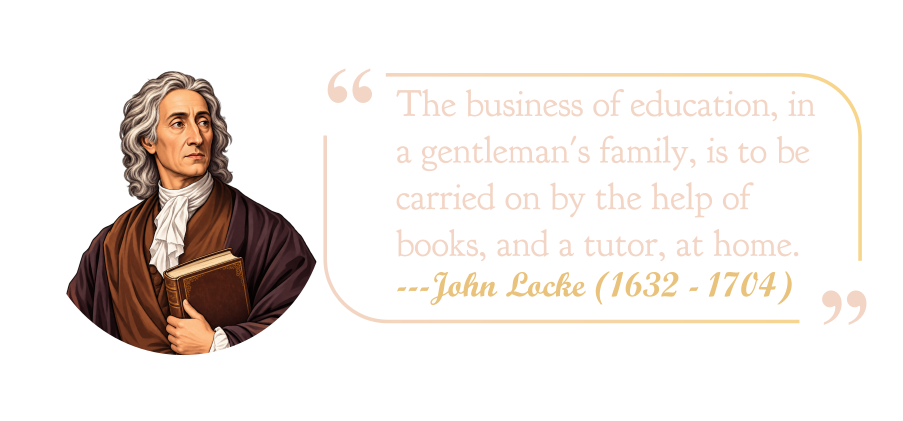
How he had that acute perceptivity that we in this age don’t seem to have even in the slightest degree baffles me. Any casual reader of classic British literature will see that from that time on homeschooling carried on by private tutors and governesses was actually very much in use and to very good ends. Sadly, six hundred years after the invention of the printing press many haven’t yet realised that formal herd education has been and remains obsolete.
However, the scarcity of books and educational content was not the only problem with the formal herd educational system so it didn’t render herd education absolutely obsolete. It was already obsolete at this point in the major part, but there are still some things here and there that kept it relevant.
As said, the availability of printed books only began to make formal education obsolete in some parts, but not entirely obsolete. This is because, for education to be sound there’s need for an extensive collection of verified good books. Not all books are good just because they are books, and there are some books better than others. The school still played that role as their qualified staff select verified good books for students and also have a good collection of books in their libraries. Having books vetted is extremely important for students.
However, with the rise of institutions like Chautauqua in the 19th century, coming up with a carefully drafted list of recommended books at intervals and other institutions following suit, including colleges and universities, the aspect of schools helping to vet books for her students began to become obsolete. If you get these lists of good books and you have the finance to get them, you get them and read them. You’d have better education than those who go to schools.
Don’t take my word for it. Listen to the words of Charles William Elliot (1834-1926), a former president of Harvard University: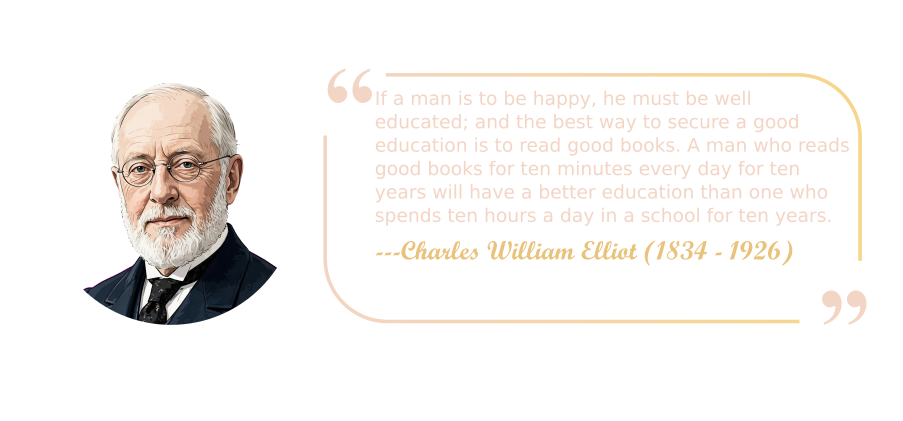
He himself was the president of a top formal educational institution. If he said this, he meant what he said and he knew what he meant. He claims being self taught yields a far better result than being taught in a herd educational setting. In the fact that he said this it means he himself saw and was sure that at the time of his saying this, even without the present technological advancements of today, the formal herd education was already obsolete. Now let us assume he said that on his deathbed (of which he did not), he died 1926, and this is 2026, exactly hundred years, it means the man already saw that what we are still meticulously preserving in this present day was already obsolete over hundred years ago. But we can only say it was obsolete on this account if every other things were equal, of which they are rarely equal. The problem of selecting good books (which according to him is necessary), parental guidance of children, individual child discipline, etc. is still required to make personal education work and be able to replace formal herd education.
Vetting of books is not all that still made the formal school setting relevant in some way. Both the buying of books and hiring private tutors is expensive. Hiring private tutors per child, household, subject, etc. has ever been more expensive than opting for herd education. It is cheaper to have one teacher stand before, say 20 students, and teach them all, than to have him or her teach only one student or a household at a time. For this reason, formal education remained the cheaper alternative for education, even though that at that point in history it was no longer the better one.
Later on came the advent of computers, digital books, and the Internet. At this point schools as the cheaper source of education in respect to educational materials found in libraries became obsolete, though not totally at the time because not many books were digitised and new digital books with latest educational content weren’t available yet. But there are still more evolutions to occur.
After this electronic book software started popping up. I think the first software I was conversant with was Adobe acrobat. There’s a file type also in my early years of using digital books that has the extension of .chm. You could read full books, manuals, etc. from your computer. These digital materials gave a much richer experience than hard print books. They had hyperlinks, popup notes, etc. I remember having an encyclopaedia at a very early age with even videos, music and all. A lot of evolution happened at this point with softwares now being made to create digital books straight from a word processor. Indie publishers started publishing books. Now professors and intellectuals (and not so intellectuals) could start churning out digital books. And because it was so cheap and distributed over the Internet to make, many started producing free books and educational materials. All this you could just reach out and grab for free or with a few bucks. It is at this point that I can say the formal herd education system became completely obsolete without any excuse and this was about up to 20 years ago.
Then came the advent of portable computers in the form of phones, tablets, dedicated ebook reading devices, and other devices that can be used for reading. Each individual with a little electronic device can have a full library of his own. With just 500mb a person can have more educational books than a school library can have, especially if it is a book without pictures. Along these came YouTube, online courses, etc., and more recently, AI. At this point herd education has been long obsoleted. All the problems that created it have now been effectively solved by technology and that far beyond measure.
As we came down history lane to this point we excused and justified the herd for education pointing to one thing or the other why it remained somewhat relevant, but at this point in time in history, formal herd education is completely obsolete and is now a distraction and is a problem itself. A problem that needs to be solved.
What Other Modes Of Education Were Available Before Herd Education?
“And thou shalt teach them diligently unto thy children, and shalt talk of them when thou sittest in thine house, and when thou walkest by the way, and when thou liest down, and when thou risest up.”
(Deuteronomy 6:7)
“But ye know the proof of him, that, as a son with the father, he hath served with me in the gospel.”
(Philippians 2:22)
“… give attendance to reading, to exhortation, to doctrine.”
(1 Timothy 4:13)
Before herd education there were forms of education and they were simplified. Education for a male child was simply this, “learn your Father’s handwork.” At times it may also mean learning the trade of a male of close kin. And for a woman, “learn to keep a home.”
From the Bible we see how God commanded that education should be carried out. Two things God commanded the Israelites to teach and it was history and law. But how did he ask them to educate their children? Concerning the things in which they were to educate their children he says, “And thou shalt teach them diligently unto thy children, and shalt talk of them when thou sittest in thine house, and when thou walkest by the way, and when thou liest down, and when thou risest up.” (Deuteronomy 6:7). This is not a mere family devotion thing, what was spoken of here was proper education. What God told them to teach their children was law and history. Parents were to teach their children and that diligently. Not slackly and not by proxy using an educational system. It was a parental duty.
The apostle Paul said of Timothy whom he took as if he were a son, “But ye know the proof of him, that, as a son with the father, he hath served with me in the gospel.” (Philippians 2:22). Our Lord also was called a carpenter (Mark 6:3) as well as the son of a carpenter (Matthew 13:55). The system of education our Lord used was that of learning his father’s trade. His disciples, Peter, James, and John, learnt their fathers’ trade and worked with their fathers in fishing when the Lord called them. So the tradition then was that fathers taught their sons their trade and that same son worked with his father.
For the intellectual part of education the apostle Paul admonished Timothy, “… give attendance to reading, to exhortation, to doctrine.” (1 Timothy 4:13). And again, “Study to shew thyself approved unto God…” (2 Timothy 2:15). And to the church of the Thessalonians he wrote, “And that ye study to be quiet…” (1 Thessalonians 4:11). And in the Old Testament, Daniel wrote, “… I Daniel understood by books…” (Daniel 9:2).
Prominent in all we have looked at as they reflect the mode of education of old times is self education and home education. This is the real thing. Teaching yourself is the best education. Formal educational system has made the vast majority that education can only be carried on within the four walls of an educational institution. Once people are out, they become redundant intellectually. Only a tiny few may still stumble upon a casual habit of personal studies just in the pursuit of how to make money. The system has blinded almost every single person from the desire to read for the love of knowledge.
In summary the education in the past which formal herd education replaced was home education. It was replaced because of the challenges we mentioned. Now that we have the technological advancement of this age we can now safely phase out the educational system that was meant to solve its problems. We may return safely back to self education and home education.
I therefore advocate the rebirth of homeschooling and self schooling. With tech and availability of educational content, we can now enjoy endless knowledge while retaining the benefits of homeschooling and self schooling.
Possible Fears Regarding Homeschooling
“And Moses said unto the LORD, O my LORD, I am not eloquent, neither heretofore, nor since thou hast spoken unto thy servant: but I am slow of speech, and of a slow tongue.”
(Exodus 4:10)
“Then said I, Ah, Lord GOD! behold, I cannot speak…”
(Jeremiah 1:6)
The world is overripe for homeschooling, however there are some fears which people may entertain which are:
- Parents may not have what it takes to teach their children. This comes from the distractions of herd education. The moment people leave schools they stop learning and throw everything they learn away so much that they can’t even teach their children the subjects they passed excellently in their schooling days.
- Parents may lack structured learning patterns. They may not know where to start from and where to end in each particular subject.
- Homeschooling demands a lot of time and physical presence of parents.
- Homeschooling requires personal discipline on the part of children. In schools they may have measures to ensure discipline in a child including corporal punishment but a child may be hard to govern in the home.
- Homeschool may not be able to provide technological and scientific educational experience which things like school labs provide.
- Home school won’t give children social skills.
These are the possible fears people can entertain about the homeschool system. But they all have answers.
Answers To These Fears
“But the LORD said unto me, Say not, I am a child: for thou shalt go to all that I shall send thee, and whatsoever I command thee thou shalt speak. Be not afraid…”
(Jeremiah 1:7 – 8)
“And the LORD said unto him, Who hath made man’s mouth? or who maketh the dumb, or deaf, or the seeing, or the blind? have not I the LORD? Now therefore go, and I will be with thy mouth, and teach thee what thou shalt say.”
(Exodus 4:11 – 12)
Here are the answers to the above mentioned fears.
- Parents should homeschool themselves too in what they want to teach. This problem is just fearfulness and not a lack of ability. Just get the textbook and other resources, read through, and you’re good. You can learn along with your child. There’s nothing wrong with that. Navigate through the educational contents together, make mistakes, get wrong answers, navigate your way TOGETHER to the right answers, and you’ll do just fine. Except of course you learnt absolutely nothing all your schooling days. You can make up with online resources like YouTube (subscribing to relevant channels), Khan Academy, Alison, etc. These online resources can be used to great effect to make up for where parents lack. Lastly you can hire a private tutor to make up to all other efforts where required. But this should be a last resort and when a private tutor is used, ensure to monitor their interaction with your children. Also ensure you hire male for male children and female for female children. Then I believe it should be for a period only and for a specific purpose.
- Development of structured learning is very easy. There are endless syllabuses online. In Nigeria you have the WAEC syllabus for example. You can also use the Cambridge syllabus. You can even use other foreign syllabuses, like the Chinese syllabus, if you find them more useful for the purpose you have for your child. And if you’re a pedant with good learning in pedagogy you can have your own custom syllabus. But ensure you have it all sorted out before you start giving birth, and please stick to one. Don’t jump from one syllabus to another. Resources itemising syllabuses are free online.
- About homeschools demanding much time and physical presence, it doesn’t really. If mothers would not be all around the place chasing rather useless careers they’ll find that they can singlehandedly school a number of children with occasional support and supervision from their husbands. From the early years of teaching children, self teaching skills should be inculcated in them. That way with time you can just give them things to read, observe, and exercise to practice and they’ll be able to do most things with minimal supervision. You just check their exercises which will reflect where they are having problems. You can teach them and help them understand the things they are having problems with. You can also give them online explanatory resources to watch. The times they are watching these things can be used to attend to other things. As they grow the time they’ll need from you for their learning will keep reducing until you can let them soar into any field of learning without your aid.
- About children’s discipline, this will be short. If schools have means to instil discipline in children, parents have far more at home. Figure it out.
- That which seems to be the biggest problem is the inability to have a lab and get lab equipment for children. But this too has a very robust solution that by far outclasses the labs of formal institutions. First the need for labs is not for all professions so only some children would have need of labs. Possibly the vast majority wouldn’t. For those who have need of labs, in the early days where a child is supposed to start being taught about scientific processes of a lab he can do his theoretical aspects without the need of a lab, but when he needs a lab he can practice what he has been taught with online labs and simulators like PhET or Labster. He can use this to simulate the processes he reads in theory. With time however, lab equipment can be bought and space created in the home as a lab. The lab equipment is not as expensive as they seem. And considering all the money you’ve saved on school fees, these lab equipment can be easily gotten. Then tell me which will serve the child better in becoming a scientist, a lab he isn’t allowed to enter while at a formal school setting or his own personal lab where he can do his studies freely?
- Of late I’ve been hearing the term social skill in academic settings and I think it means developing skills that help in relating well with others and since it is more often heard in the coeducational settings, I’ll suppose it means relating well with people of the opposite sex. That is not a skill. If you know what’s good for children, this would make you take your children out of herd educational institutions because of these so-called social skills. Children don’t need to mingle with other children to develop well. That children need to mingle with other children is a farce. You can be their only company and you’d see them picking habits from you. In a corrupt world like ours, removing your children from formal educational institutions is to keep them from mingling with corrupt children.
To every fear, there’s now an answer. And seeing that the system of the formal herd education itself is now a problem, we ought to get rid of it by all means.
Suggested Change Over Plan
“To every thing there is a season, and a time to every purpose under the heaven… a time to keep, and a time to cast away.”
(Ecclesiastes 3:1, 6)
“… Now that which decayeth and waxeth old is ready to vanish away.”
(Hebrews 8:13)
I do not anticipate a sudden switch to homeschooling. As I said it is best to have everything sorted before one begins a home. People who have used the formal herd educational system already may still switch to homeschooling but should remember that they should avoid changing the curriculum. So they should maintain the curriculum their children were using while using the formal herd education. The main reason for this is that what they have learnt so far should be brought to a good conclusion though I know many of the knowledge students gain in the formal educational system are useless knowledge. You may just teach them specific knowledge of your choice, discarding what you are confident they don’t need. They’ll do just fine.
It is not something one should jump into carelessly. Careful thought needs to be put in place. Why this advice is essential is if one person goes into it and fails, due to his own poor planning, it puts the whole idea in disrepute despite being so good and well overdue. For the sake of the coming generation which the herd schooling system is all poised to destroy, let’s give good thought to this and execute it with a master stroke of excellence. Let the time of maturity of these children come and let the world compare and see for themselves the clear difference between the home schooled and herd schooled.
For the society and nations I hope that people would opt for it and phase out the herd schooling system in most parts. But it should be phased out and not jumped into. Home schooling requires women to give up their useless careers and the question is are they willing to do so? If they’re not willing and ready, the herd schooling system is the only option they have and how sorry I am for those children who must yet pass through such a system. But this should not stop the good parent with acute perceptivity to commence homeschooling immediately.
I hope governments would also support the home school system and provide materials, resources, and means of certifying the knowledge acquired through homeschooling. There are governmental ways to encourage it and I hope it gets all the governmental support it can get. However, the good parent with acute perceptivity should not be deterred should it fail to get governmental support. The support is just to enable reluctant parents without acute perceptivity to overcome their inertia. Nothing really to benefit or lose from governmental support.
What Next For Schooling Institutions
“For thus saith the LORD of hosts; Yet once, it is a little while, and I will shake the heavens, and the earth, and the sea, and the dry land.”
(Haggai 2:6)
“And this word, Yet once more, signifieth the removing of those things that are shaken, as of things that are made, that those things which cannot be shaken may remain.”
(Hebrews 12:27)
Now there would still be a need for herd education for particular fields of which the only one I can readily think of is the various armed forces. The army, police, and other forces would still have the need to train their trainees together as part of education. You may be able to homeschool a child for self defence, but you can’t homeschool a child into a soldier or a police and related careers. And there may be one or two other careers here and there that will require such herd training.
Schools however can still function as high tech research and production centres, support centres for parents, and maybe exam certification centres. There should still be some roles for them to play in a homeschooling system, but not essential roles.
Conclusion
“Behold, the former things are come to pass, and new things do I declare: before they spring forth I tell you of them.”
(Isaiah 42:9)
Seeing what brought about the educational system in the first place, and seeing the technological advancements we now enjoy by the grace and mercies of God, it is obvious that times have changed and therefore the methods of doing things must also change.
We have gone through the evolution of technological advancements as it affects pedagogy and it is so obvious that the formal educational system has been outdated for years ranging from twenty years to six hundred years. Parents should be good to their children and begin switching to the homeschooling system with utmost alacrity.
In the next part of this discussion I shall be talking further about why the formal herd educational system ought to be jettisoned. This time we shall be making a stronger point against it, not just as something obsolete but as something that has become a nauseating problem that now needs to be solved by being done away with and finding something else in its place. It’s going to be very damning. Please don’t miss it.
May God help us find and enable us to safely make a successful switch to that which is better, safer, and holier, in Jesus’ name. Amen.
Prayer: Dear Father and Lord, as we consider this very important subject on the best way to raise our young, teach us to know the right, good, and most efficacious path. Help us to look beyond the smokescreen of conventions to see by a clear sight which will be of profit to our young. Help us also to make the necessary sacrifices to make this happen. This we ask in Jesus’ name. Amen.