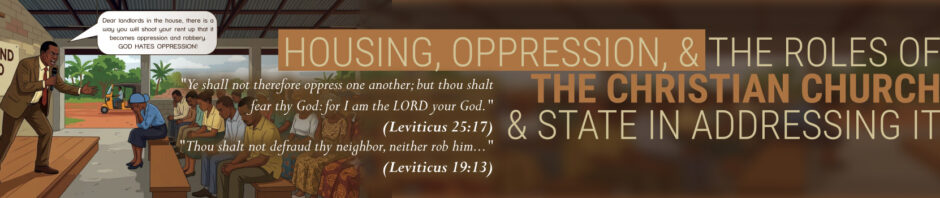
“Ye shall not therefore oppress one another; but thou shalt fear thy God: for I am the LORD your God.”
(Leviticus 25:17)
“Thou shalt not defraud thy neighbor, neither rob him…”
(Leviticus 19:13)
“Woe unto them that join house to house, that lay field to field, till there be no place, that they may be placed alone in the midst of the earth! In mine ears said the LORD of hosts, Of a truth many houses shall be desolate, even great and fair, without inhabitant.”
(Isaiah 5:8 – 9)
Shelter is a fundamental necessity of man and is not in any way a luxury. At all times in the life of an adult he should be able to afford a decent house irrespective of his earnings or status. If his earnings be high he may choose to live in a luxurious house. That can be termed luxury, but a decent house is not. Not to be able to afford a modest house or to live in a dilapidated house is to be dehumanised. A man should not live in a house that is characteristic of a dog’s house.
So on this basis we see the cardinal importance of shelter to each and every citizen. Sadly, this necessity has been targeted by business people who have proven not to care anything about ethics, morals, and fairness. I have closely monitored the development in the housing sector and the things I’ve noticed are what birthed this article.
The Prevalent Oppression In The Housing Sector
“He that oppresseth the poor reproacheth his Maker: but he that honoureth him hath mercy on the poor.”
(Proverbs 14:31)
For some time now I’ve observed with dismay the oppression going on in the housing sector. As said, shelter is a necessity, for this reason landlords and agents have the power to oppress tenants with a high level of impunity. In Nigeria, people with intention to oppress and make unjust gains are often attracted to essential sectors like housing, food, and transport. So the mere fact that shelter is a necessity makes it a juicy spot for oppressors.
A friend told me he lives in a place where he pays one million Naira per annum as house rent. He told me that just three years ago when he moved in he payed only three hundred thousand for rent. I marvelled at that. Supposing someone works as a civil servant, or any standard job, is that how his salaries increase? You start with a salary of three hundred thousand and within three years you’re already earning one million. So on what justifiable basis should one’s rent increase from three hundred thousand to one million in just three years? It doesn’t make any sense.
I’ve heard of similar things from all around the nation. The outcry is great but muffled. Muffled in the hustle and bustle of the working class Nigerian struggling for survival. The lamentations are heard everywhere if we would only take more heed. I boarded a bus heading towards Mararaba once and the things I heard about housing oppression made me so sad. One of the people talking (a woman) said her house help fell sick and she had to send her to the village to recover. She said that when the house help got to the village and narrated how things were, particularly how she’s struggling with house rents they started pleading with her to come back to the village. Others responding to that said the only thing keeping them from going back to the village to avoid the oppression of landlords is shame. Now the Mararaba axis is one of the cheapest places within the proximity of Abuja, so if that is oppressive and causing so much groan, what shall we say about the more expensive parts of Abuja? The groanings are loud but muffled.
People don’t have time to go to court for tenancy cases to defend their rights. How shall they leave their jobs to attend court hearings? Did their employers hire them to be absent from office to go for court hearings? How shall they then engage in any form of activism seeing there’s no time? Those who pretend like their activist are only political activists. They do nothing for the masses and from the way they act I won’t be surprised if they’re in the payroll of the highest bidding politician. Some are both activists and also political aspirants at the same time. They are activists for their own selves. These can’t do anything for the masses and so the cries of the suffering tenants are muffled.
The Stance And Standing Of Landlords
“That no man go beyond and defraud his brother in any matter: because that the Lord is the avenger of all such, as we also have forewarned you and testified.”
(1 Thessalonians 4:6)
“Woe unto them that join house to house, that lay field to field, till there be no place, that they may be placed alone in the midst of the earth! In mine ears said the LORD of hosts, Of a truth many houses shall be desolate, even great and fair, without inhabitant.”
(Isaiah 5:8 – 9)
I have tried locally to engage landlords and also heard interactions of others with landlords and they make their points clear, the houses are theirs, you can’t dictate to them what to do with their houses or the prices they should set as rents for tenants. If the tenants are not content they can go elsewhere. Simple. They’re absolutely right. One told me, “go and build your own house and give it out at fifty thousand.” It was funny but he was right. A landlord can build a self contain on the outskirts of Abuja and put it out for twenty million Naira per annum. It’s up to a tenant to accept it or not to accept it. If the house is empty for five years it’s a loss to the landlord and to nobody else. Why should you cry for the loss of another. It’s a free world. So they’re absolutely right.
Where however there’s a problem is landlords conniving together to increase house rents and by so doing force people to pay unfavourable rents. You’re free to shoot your own price up to the moon and stars, but why would you move others to shoot their own prices up too? Why would landlords fix prices so as to deny the tenants the benefits of competition? I have witnessed landlords calling other landlords and saying things like, “all the landlords in this area have increased their house rents, it’s only your house that is going for so much.” And sometimes, or maybe many times, the claim is untrue. This is also done by the agents and caretakers of landlords who call the landlords whose properties they manage and other landlords whose contacts they have to urge them to increase their rents. This is wrong on all grounds and I suspect is even illegal.
Price fixing is a crime according to the FCCPC. I believe this applies to house rents too. So morally and legally there’s a great fault with landlords conniving to shoot prices up. The unanimous shooting up of prices gives the tenant no choice but to pay unfair prices for rent. The coordination of agents has made this very successful. And by this means the oppression of tenants is great.
The Role Of The Christian Church In The Matter
“… the church of the living God, the pillar and ground of the truth.”
(1 Timothy 3:15)
“Ye are the salt of the earth… Ye are the light of the world… Let your light so shine before men…”
(Matthew 5:13 – 16)
I’ll talk on the role of the church and the government in tackling this oppression, but I’ll start first with the church for reasons I’ll explain shortly.
We have said landlords have the freedom to set the prices of their houses to any amount they so wish. It’s a free world. However, there’s a way that you’d use your freedom that it becomes oppression. God hates oppression and speaks against it constantly through the Bible. It is therefore immorality to exercise ones freedom in a way that amounts to oppression.
When landlords unanimously increase their house rents to force people to spend beyond their means and so force them into hardship is godless oppression. For landlords to get so involved in this level of oppression reflects nothing but deadness of the conscience where the fear of God is fast dying out. As the Christian church is the custodian of the conscience of the Christian people, where the conscience of people have started dying so much that they oppress the poor for gain, it is the role of the church to step in with sermons from the pulpit to speak the fear of God to the hearts of men and life to their dying consciences. It is a more proper role of the church to handle matters of conscience than the government.
There are ways that the government would handle matters it would seem to be oppression of landlords themselves. The best way to ensure good conduct and freedom going side by side is to allow total freedom to be guided by a lively conscience. By the free will good and just deeds will be done.
Had the issue we are addressing been a matter of governmental housing schemes for example, we’d talk of the government first. But these are privately owned properties. So the task of regulation of these things primarily falls on the Christian church because it ought to be regulated by the conscience.
Furthermore, governmental solutions would take time to implement but if men begin to listen to the voice of their conscience and know it is against God’s will to oppress one another, the result would be faster while governmental efforts would later cement the effort to ensure affordable housing for all. For this reason let the church stand up to its duty in reawakening the consciences of her members which are in a state of slumber, hoping of course that they are not dead.
Seeing there’s an outcry, which is but a muffled cry of the truly oppressed, it behoves the church to address the matter by sermons and other ways to advice, admonish, and even enjoin landlords who profess the faith to deal fairly and truly with their tenants in the fear of God.
The Role Of The Government In The Matter
“For rulers are not a terror to good works, but to the evil… For he is the minister of God to thee for good….”
(Romans 13:3 – 13:4)
Now the government too has a role in addressing the issue of oppression of tenants. The government is minister of God for the good of citizens. The government has laws in place meaning the government is well aware of the need of laws to tackle the oppression of tenants and protect them from exploitation, and they’re living well up to that responsibility. There are however things I’ve observed that may need improvement.
I read that the law governing how landlords can increase their rents is at 150% every year. I know these laws are not meant for landlords to exploit. It is not designed to constrain them to increase their house rents by 150% every year, rather it is designed to restrain them from going beyond that should the desire to increase their rents arise. However, since it is permitted by the law landlords can as well exploit and be raising their house rent every year. As I’ve said of a friend whose house rent increased from N300,000 to N1,000,000 within three years. I do suppose that since nobody gets an income increment of 150% every year in any standard job, including the public service, house rents shouldn’t be allowed to go up by that rate every year. There are times when people gain up to that amount of increment in their earnings, but it is rare like when someone gets a new job with far better pay, or maybe one is in business and was able to boost sales by some favourable wind. But that is rare and probably won’t happen yearly as to land a better job every year. Furthermore the real value of shelter doesn’t go up by 150% from what it was the previous year. For these reasons giving landlords the freedom to increase rents by 150% every year is exorbitant. That law needs to be reviewed.
The next is to create alternatives for tenants. The reason why tenants must bow to the will of landlords is because they don’t have alternatives. So the government through the ministry of housing should give tenants an alternative should house rents go up. And no, by alternatives to renting houses from landlords I don’t mean making provisions to make them live on trees. We’ll look at two viable alternatives.
The first of this alternatives I mean is by embarking on mass housing schemes with low rents for tenants to rent. Such properties should be perpetually owned by the government and be perpetually for rents for low income earners. It should be cheap but functional. What matters here is quantity not quality. More minimalistic affordable houses. That way tenants can live in these houses should they find it difficult to pay rents for privately owned houses.
With these schemes in place it would regulate to what extent landlords can shoot prices up. Just like we have in the educational sector. We have government schools and private schools side by side. It will do well too for housing for the wellbeing of tenants.
I’ve seen some schemes that seem to have a semblance to what I’m talking about, but the problem with what we have so far is government doing mass housing scheme to sell properties to buyers. The difference between what I’m proposing and what is on ground is that what is on ground sells to buyers, what I’m proposing rents to tenants. There’s a great difference. The housing scheme that I see that they say is for low income earners seem to be a sham to me. At best it is a good intention with poor execution. I say this as a close observer of these schemes.
The first fundamental problem it has is the error that of building houses for low income earners to BUY. The truth is that low income earners are looking for houses to rent and not to buy. In some of the housing schemes people pay up to fifty thousand Naira every month to purchase a house. With minimum wage at seventy thousand Naira, which low income earner can spare fifty thousand Naira every month? So if truly the target is low income earners, we’ll build houses for rent and not for sale.
The second issue is based on the first. When you build houses for sale you build houses for the rich and there’s no way to be sure it is benefiting the poor. I’ve seen how the rich and even companies buy up so many of these mass housing units only to start renting it to the poor at exorbitant prices. When a person or company can afford to buy up whole streets upon streets of houses, are they poor? So these schemes are benefiting the rich and not the poor. It is absolutely wrong to use public funds to serve the rich and neglect the poor.
Thirdly, it pays for people to save up and build their own houses themselves. When you consider the costs of these houses, it is usually exorbitant and it is expected to be. If you wish to build a house, you approach the seller directly, buy the land, get your building materials, and pay for the labour to get it built. When the government do the same, someone else buys the land and builds the house. He’s rendering you a service that won’t be for free. And so you will pay for both the house and the service. And you will actually buy the house at the price they want you to buy it, not at the price it is really worth. So the government really need to stop building houses to sell. If they must get involved in building, it should be strictly for rent.
Lastly, these mass houses are usually very low quality houses. They are wonderful houses to rent but not to own. We need to have a higher expectation and desire for our citizens. How can one own such houses? It is better to give these low quality houses out for rent and when the occupants are wealthy enough they can build something more tastefully finished to own.
Now there is a major difficulty for a democratic government to build houses for rent. This is because the return on investment from rents comes in the long run. Way beyond four years. So such a project can’t benefit an office holder of a democratic system. But when such housing units are sold instead, the returns are faster in their millions per unit. Money comes back faster and so is more favourable to the interests of the office holders in a democratic system. As we think on the issue of governmental involvement in housing we must acknowledge this problem as a challenge and think of how to circumvent it. But if it can be dealt with, the government itself would be a major beneficiary in the long run. Each new mass housing is a one time investment that brings in a substantial perpetual stream of revenue even when each unit is rented out at affordable prices.
The second alternative is to revive the Federal Housing Scheme where people can collect low interest loans to own a house. This should be made easy to access. Right now the Federal Housing Scheme works but is so so hard to access. There is an amount a house rent would cost that should rather be used to own a house and not to rent. So houses shall be kept cheap and affordable. If houses become too expensive, tenants should rather use that money to own a house over a long run.
These two alternatives places the tenant in a strong position to negotiate profitably with landlords. This way house rents would be regulated without having to make laws that would seem like oppression to landlords over their own properties. They’ll be constrained to deal fairly with tenants of their own free will.
Statistical Approach To Standardising House Rents
“Divers weights are an abomination unto the LORD…”
(Proverbs 20:23)
“Ye shall do no unrighteousness in judgment, in meteyard, in weight, or in measure. Just balances, just weights, a just ephah, and a just hin, shall ye have: I am the LORD your God…”
(Leviticus 19:35 – 36)
Standardisation of prices of things, especially essential commodities, is highly important to ensure fairness. As a matter of fact God hates divers weights. Standardisation would ensure that the right and fair value of things are drawn up and adhered to. This is well pleasing in the eyes of God.
Before the issue of exorbitant house rents can be addressed in truth, what is fair and true ought to be carefully drawn out before a proper admonition can be given to landlords in churches. Without knowing how to draw up these values, how shall one know what is fair and what is not? It will also help the government in drawing rents when the time comes to implement mass housing schemes for rent.
Like many other commodity, houses ought have standards by which they are valued for rent.
In my previous article on housing I had said the following:
“As I grew up into adulthood I was given a piece of advice which I think is good and is a good yardstick to measure if or not a house rent is good or not. The advice says, your house rent should never be more than your 3 months’ salary. Therefore, the person earning a hundred thousand Naira ought not to pay a rent higher than three hundred and sixty thousand Naira. And a person earning the current minimum wage of thirty thousand Naira ought not to pay a rent higher than ninety thousand Naira. Anything beyond this is to do injury and disservice to yourself.”
This holds true and three months is actually the maximum your house rent should be. It should actually be much lower. House rents eating up to three months of someone’s salary, particularly those of lower income, is already putting one in a tight financial corner. Anyone forcing a tenant to pay beyond this is oppression.
Each community must therefore draw up house rents standards based on the earnings of the people in their community, not the desires and whims of landlords and their agents. Landlords should personally be abreast of the prevalent earnings before setting their house rents.
In this light I think it would be a great idea for the Federal Bureau of Statistics to provide stats on mean, median, and mode salaries being paid to staff of each area of the country. With these stats the rents of different types of houses can be drawn up based on certain criteria in different areas. A studio apartment for example would be for the lower earners and people just starting out in their careers and should not exceed three months of the salaries in this range. One bedroom would be slightly higher as it would be for people who earn a bit more and have more years working experience. Possibly for people getting ready to marry and settle down. Two bedrooms would be for little families with more earning and advancement in their careers, and considering the fact that the burden of house rents would now be borne by both husbands and wives, but with more expenses from child bearing which would mean their finance would be a bit shaky. Lastly, three bedrooms for a bigger family who are now more stable. Anything beyond this can be treated as luxury and probably be unregulated. All these and more should be considered in the process of drawing up standards.
Without these data even those who want to deal fairly with their tenants wouldn’t know when they are oppressing their tenants, when they are being fair, or when they’re undervaluing their property to their own detriment. So it is very expedient to have these data and by these means draw up what is fair to landlords and tenants alike.
Conclusion
“Happy is that people, that is in such a case: yea, happy is that people, whose God is the LORD.”
(Psalm 144:15)
In this article we have spoken about something I consider one of the pillars of a happy nation which is affordable modest housing. Shelter, being a necessity for man, must be administered with a good conscience. Landlords dealing fairly with their tenants in the fear of God. We looked at the role of the church, the government, and briefly at the role of communities and landlords themselves to ensure that houses are rightly valued. Lastly we saw the need of standardisation.
It is my belief that if we can all play our part we shall be leading the way into a more happy and prosperous country. Time will fail me to enumerate and explain how affordable housing would translate to prosperity and advancement in a nation. In fact the article would be too long. But let it suffice for us to know that it is the will of God not to oppress one another, and let this knowledge lead us to deal fairly with one another.
Thank you and God bless you.
Prayer: Dear Lord and Father. You who commanded us severally not to oppress one another in your holy word, teach us to live according to this command. Help us to correct the evils going on in the housing sector with our personal choices, sermons, government policies, and every means available to us. In doing this may we find our lives as a nation to be happy and blessed. The natural benefit of having you as our God. We pray for the right eyes and ears to see this. This we ask in Jesus’ name. Amen.