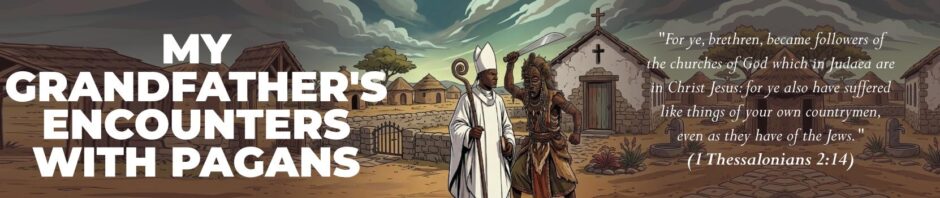
“For ye, brethren, became followers of the churches of God which in Judaea are in Christ Jesus: for ye also have suffered like things of your own countrymen, even as they have of the Jews.”
(1 Thessalonians 2:14)
Today we’d take a look at the encounters my maternal grandfather, apostle Simeon Moye Ogunsiku, had with the pagans of his village. All through my grandfather’s time as a Christian and a church leader he encountered the persecutions and challenges from the pagans in Iwopin. These things happened both when he served as the deputy head of the church as well as when he served as the actual head of the church.
While he was still the deputy head of the church, there was an idol procession that is usually done in Iwopin. The name of the idol is Muwaro and only men were admitted into the secret society of men that worshiped that idol. The practice in the village at the time is that when they are about to start their procession everybody is to go indoors except the worshipers of the idol. Everybody in the village complied with them because if they didn’t something mysteriously bad would happen to them. So when they want to start the procession they’ll first start beating their drums and chanting at their shrine that sounded something like, “hor hor hor hor.” Then everybody would run indoors and lock their doors. And the idol was so powerful that all through the procession the very ground would be shaking violently. So when people run indoors they must pull off every single thing that is hung on the wall and place them flat on the ground. Even everything that is resting on the wall and everything that can easily fall off a table or something must be placed flat on the floor, because if they didn’t, the violence with which the ground shook would cause them to fall and break. And this shaking would be felt all the way from Iwopin to Ijebu Ode, which has a linear distance of about 46 kilometres from Iwopin according to Google map, so much that anytime there’s a procession of Muwaro the people in Ijebu Ode would know that there is a procession of Muwaro going on.
Now the church was intent on simply complying with the norms and endeavoured to let her members stay indoors during the procession. So whenever the procession was on they chose not to hold church services so that their members won’t be hindered from coming. However, these pagans wanted to use their procession to hinder the church completely from holding her services. To avoid the clash, the church leaders would go to the palace of the king of Iwopin that they are having an important program and so inquire when they want to do the procession, the king being one of them. When they say it is going to be in the evening, the church would choose to hold their service in the morning. However, the moment the church bell rings in the morning and members have started coming for worship, they’ll start chanting in their shrine to begin the procession so everybody will run back to their homes. When that happens, they’ll deliberately let their procession drag on till evening so that the church service won’t be able to hold that day. And when they say it will be in the morning, they’ll not do their procession till evening when the church rings her bell.
This went on for years but the patience of the church leaders wore out and they came together saying, “enough is enough. We cannot keep running for these people. We have given them a long rope. When they say it is in the morning, we would leave them. It is when it is in the evening when we want to start our service that they’ll come out with their idol. And if it is in the evening they start in the morning and do their procession all day. This year, we shall confront them.” So with this resolve, the pagans thought to go against their agreement again. So the moment the church rang her bell they started beating their drums, shouting, and chanting. As usual everybody fled indoors and locked their doors. But the church elders stood their ground. The elders were there, the choir members were there, and my grandmother too was there with the church elders. So when the procession started, the church elders and choir started singing the hymn, “Onward Christian Soldiers” in Yoruba. Then these pagans came out having white wrappers round their waist.
So as the church elders and their company continued to sing they couldn’t bring out the idol for the procession. So they ran quickly to call the king, probably hoping to put fear in them. The king ran to the place shouting, “hey! You allowed a woman to see members of our secret society?” The king of course knew the pagans were at fault but was instead trying to pin the fact that a woman was amongst them on the church as a wrongdoing on their part. But that didn’t move the elders and their company, for they had been patient a long time and had put up with the naughty manners of the idol worshipers.
So this issue became a serious one that resulted in several court cases. When they would not get a fair hearing from the king of Iwopin, they appealed to the king of Ijebu Ode to intervene. This was because the king of Ijebu Ode was superior to the king of Iwopin. But when the case wasn’t resolved there too, they took the case to the king of Lagos as the king of Lagos was superior to both. This system of monarchical hierarchy was a traditional one and was in place before the arrival of the colonial masters. It was in Lagos they got a fair hearing. The king of Lagos told the pagans that they were clearly at fault for going against their own words and agreement. He also told them that it was wrong of them to be deliberately seeking to prevent the church from holding her programs when the church had been considerate enough not to organise her programs at times that will clash with their processions. And also commended the church for putting up with their naughty ways for such a long time. He then passed a verdict that they must stick to their agreements. At whatever time they say they’re going to hold their procession, they must stick to it and let the church have their time of worship without hindrance. The king that gave this verdict was king Falolu Dosunmu.
Now, it is good to note here, especially those who claim that the way forward for Africa is to turn back to these dumb idols, how that justice was far from the ways of these pagans. Even a little child set to preside over such a case would know that if a man should give his word, it is absolutely wrong to go against it. But for the malice, lack of character, prejudice, and faulty reasoning of those who presided over the case it dragged on until it got to the king of Lagos. Now this king Falolu Dosunmu bore the same name as one of his predecessors who was simply named king Dosunmu. This first king Dosunmu was noted to have welcomed the noble missionary, Thomas Birch Freeman (1809-1890), courteously during his visit to Lagos for the work of the ministry. It was written of his missionary tour around the regions of South West Nigeria, “In late 1854, he returned to Abeokuta and then to Lagos, where the Wesleyan Missionary Society had set up station two years earlier. In Lagos, Freeman was cordially received by the European missionary, Gardiner, the Lagos king, Dosunmu and the English Consul, Campbell.” This happened about a hundred years before the time of this verdict. So kings of Lagos at those times seemed to have had a favourable disposition to the Gospel of Christ which may have been responsible for the fair hearing they got. Under the influence of these dumb idols recommended by some, justice could not be found, and what man doesn’t know that justice is the pillar of civilisation?
So that’s how the case was closed. It was a great victory for the church because the king of Lagos was the highest judgment seat to appeal to. Beyond this I don’t think there was any other place to seek justice. And it was good that God delayed their victory until they got to Lagos so that the victory would be final and sealed. And not only was this a great victory in court, but the power of this Muwaro became really weak after the verdict was passed. After it, whenever the procession was on you couldn’t even feel the impact of it from few kilometres away when initially its impact could be felt 46 kilometres away and the ground didn’t shake anymore.
There was another set of idol worshipers in Iwopin in those times. They had this masquerade called “Awini” and had two processions. One was every year and the second was every three years. They had a path that they followed from their shrine straight to the king’s palace. So a small mock house would be made within the vicinity of the king’s palace and when they arrive at the palace they’ll break it down with their sticks. This signified that they were above the law and that not even the king could do anything against them. Their processions were characterised by theft. When the procession is on everybody would have to take all their things into their houses or cover them up properly, else they’d go with them.
So after the Muwaro incidence, as an act of provocation they changed the path of their procession and chose to be coming through the church premises on their way to the king’s palace. At this time my grandfather had assumed actual leadership of the church. Now, the church had a perimeter fence made of bamboo round the church premises. So they’ll come and pull it down, pass right in front of the church then head to the king’s palace. The church leaders spoke to them asking why they chose to be going through the church premises and tried to dissuade them from it, but they would not be dissuaded. They kept pulling down the fence and going through the church premises to the king’s palace.
So one year, my grandfather said it was time to confront them. So he made an arrangement with all the members and elders that they should all come to the church to withstand the pagans when they tried to make it through the church premises. They all gave their consent and assurance that they will be on ground on that day, saying they were solidly behind him. But when the day arrived, for fear of the pagans, all of them gave excuses as to why they couldn’t come. Some said they overslept and didn’t know when the time passed. Some said they went to check their traps. Others said they went to the lagoon to check their fish nets. Only one elder came with him that day. So he stood with that church elder on the path by which they went to the king’s palace. So when the pagans came, they pulled down the Bamboo fence again and started making their way to pass by the front of the church and go to the king’s palace when they met my grandfather and the elder. So my grandfather told them that they won’t use that path anymore on their way to the king’s palace. They said they were going to make use of the path whether they liked it or not. But my grandfather insisted and didn’t move an inch for them to pass. The elder that was with him didn’t say a word but stood firmly by him and looked on while the hot debate was ongoing.
The conversation lasted for a long time and was full of threats which didn’t diminish the resolve of my grandfather one bit. My mother and some other members who were around stood very far off and watched the face off. The pagans wore costumes of different colours that hid their faces but had little holes through which they could see around. Each man held a cutlass, but the head of the procession wore a white costume and had a special glistering cutlass in his hand. So after the face off dragged on he raised the cutlass in the air to use it on my grandfather but he could not bring his hand down. Though his cutlas was raised up my grandfather and that elder remained steadfast and didn’t give in. When after a while that the leader of the procession saw that he couldn’t use his cutlass on my grandfather, they turned their backs and started going back.
So when one of the members that had promised to be around to confront the pagans saw that the whole face off ended in victory and they had begun to leave, trying to hide his cowardice, came running to where my grandfather was with a look of resolve shouting, “where are they? Where are they?” When one of the pagans saw him and the boisterousness with which he came, he gave him a clean cut on his arm, just below his shoulder. When they had given him a cut they left. To me, that was a just reward. To be a coward and go back on your words is bad enough and such a defect in one’s character should make one contrite and silent, but to pretend to be brave and come in with resolve when it was certain that the face off was over was hypocrisy. So the cut he got was fair enough to teach him not to be hypocritical.
My grandfather was so touched by the resolve of the elder who stood unflinchingly by him even in what could have meant death that he prayed earnestly for the man and blessed him with many blessings, and when he was about to die handed the church over to him with many instructions to guide him. This man is still alive today at a grand old age of almost 120 years at the time of my interview with my mum.
Some members of that group of pagans, infuriated by the outcome of the face off, threatened to come at night to burn the entire church down to the ground. They uttered many other threats which they never carried out. But these people that uttered these threats didn’t live up to a year before they all died. Not a single one spent up to a year.
While my grandfather was still the deputy head of the church, some people broke away from the church to start a new church which I don’t think is advisable to name, but the name was very Christianly. They tried to pull people away from the church with the intent of destabilising the church. The brother to the deputy of the head of the breakaway faction tried to induce the wife of the head of the church to whom my grandfather was deputy to join them because she was his sister, but she refused saying, “this is my husband, I can’t abandon him.” That’s to tell you how evil their minds were. This deputy of the breakaway faction was a first cousin to my grandmother. But they did succeed in pulling away some people after them but could not succeed in pulling people in the leadership away. Though they had been a part of the church and had broken away with a Christian name they were into a lot of diabolical practices. To further destabilise the church they tried to use their diabolical means to send a smallpox spirit by Shokpono (the god of thunder in Yoruba) into the midst of my grandfather’s church. But as was common with my grandfather, it was revealed to him in a dream, so he fasted for three days. When they eventually sent the smallpox spirit, it backfired and a grievous smallpox broke out in the midst of the breakaway faction and was so grievous that many of them died. One of the survivors almost lost his voice and his whole body was full of sores and blemishes. It was concerning him that my mother asked her mum why he was speaking with a hushed voice. This was one of the times my grandmother was angry about my mother’s inquisitiveness. She had asked her “why is this man speaking this way?” Mimicking how he spoke.
This reminds us that people can, by a very godly name, perpetrate what is evil in the service of the Devil. It reminds me of what Luther once said that goes thus:
“In the year 606, Emperor Phocas, the murderer of that good and godly Emperor Mauritius, and the first erector of the Pope’s primacy, gave this temple Pantheon to Pope Boniface the Third, to make thereof what he pleased. He gave it another name, and instead of All-Idols he named it the Church of All-Saints; he did not number Christ among them, from whom all saints have their sanctity, but erected a new idolatry, the Invocation of Saints.
“In my chronicle I expound the name of Bonifacius thus: Bonifacius is a Popish name, that is, a good form, fashion, or show, for under the colour of a good form and show he acted all manner of mischief against God and man.
“As I was at Rome, I saw this church; it had no windows, but only a round hole on the top, which gave some light. It was vaulted high, and had pillars of marble stone so thick that two of us could scarcely fathom one about. Above, on the vault, were portrayed all the gods of the heathen, Jupiter, Neptune, Mars, Venus, and how else they are called. These gods were at a union, to the end they might fool and deceive the whole world; but Christ they cannot endure, for he hath whipped them out. Now are the Popes come, and have driven Christ away again; but who knoweth how long it will continue?”
My grandfather also experienced this kind of deceit, how that by the pretence of good and holy intentions men would seek to do mischief against the work of God and against man. But by the grace of God the plan of the Devil failed, he was publicly disgraced and his messengers became a thing to laugh at, and rather the name of God was glorified. Men therefore need to be careful not to allow themselves to be deceived by the mere name or appearance of a thing lest they join themselves to the Devil while thinking they are seeking God.
I could safely say that most times (if not all) that people break away from a parent church, it is for evil. At best the motive may be good but when the motive is good it is not usually entirely pure. So people should be very wary of the concision. The Bible warns us of it where it is written, “Beware of dogs, beware of evil workers, beware of the concision.” (Philippians 3:2). Concision means to break something into smaller parts. And Jesus prayed, “Holy Father, keep through thine own name those whom thou hast given me, that they may be one, as we are.” (John 17:11). We can see through these verses how that concision can’t be of God, and to break the body of Christ can’t be his will, not even if the break away party have for their name, “Holy Father Eternal Heavenly Church.” All we do must be aimed at bringing the church together. Of course not to condone heresy in the bid to unite the church. We must aim at uniting the church in the purity of his word. All that divides his church is not of him. I spoke in detail about these things in my book, “UNITY IN PURITY.”
After many years of eventful and meritorious leadership with victorious encounters, my grandfather later fell sick and had to relocate to the house of my great grandfather. It was there he spent his last days.
This article is an excerpt from my book “THE LIFE OF APOSTLE SIMEON MOYE OGUNSIKU.” The full ebook is entirely free.